20 Canned Responses for Customer Service (With Examples)
 by Alex Yumashev ·
Updated Sep 16 2026
by Alex Yumashev ·
Updated Sep 16 2026
You have six tickets about the same outage and another asking for an update. Typing the same reply seven times helps nobody. Canned responses are saved replies you can reuse for recurring customer service questions, then edit to fit the person asking.
Below are 20 canned response examples for customer service and IT support. Each reply is ready to copy and paste. Choose one that fits the conversation, and only promise actions you're ready to take.
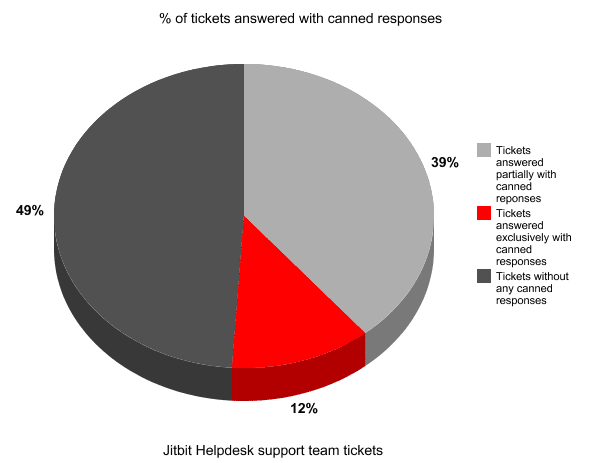
After more than 10 years of running a SaaS help desk company (and also providing support to our customers) here's the list of our most frequent and most used canned responses:
Templates for recurring customer requests
Downtime acknowledgement
Shit happens. And when it does - you'll get dozens of support tickets: "Help, it's not working!" "I get an error!", "Are you guys there!?" - have a canned response that confirms the issue and lets your clients know you're working on it.
Thanks for reporting this. We're aware of the outage and are working to restore service. I'm sorry for the disruption. We'll keep you updated as we learn more.
Critical times like this is when you need the most resources, don't waste it on writing the same thing again and again.
Calming an angry customer
Sometimes customers can be angry and even rude. Don't let this get to you, have a calming canned response ready:
I'm sorry this has been such a frustrating experience. I'm reviewing the conversation so you don't have to explain everything again. Let me look into what happened and what we can do to help.
This also a psychological hack that helps keep your head clear, not take it personally and make this negative energy simply fly by and go into sand.
Bug report response
When someone reports a bug, respond with a nice confirmation:
Thanks for reporting this. I've logged it for our team to investigate. We don't have a confirmed fix date yet, but we'll let you know when we have an update.
Feature request - a "yes"
Great suggestion. We've added it to our roadmap. I can't promise a release date yet, but it's something we plan to work on. Thanks for explaining how you'd use it.
Feature request - a "no"
Thanks for the suggestion. We aren't planning to add this at the moment. Could you tell me a little more about what you're trying to accomplish? There may be another way to get you there.
Common issues, FAQ and KB items
A good help desk app has a built-in FAQ and "Knowledge base" modules that are tightly coupled with the canned responses (shameless plug: Jitbit does!), so whenever you see a common question - send a link to a KB-article with a click of a mouse. This includes:
- Product specific questions
- Billing and shipping issues
- Refunds (accept and deny)
- Privacy policy, return policy
- Username/password reminders
- Discounts, promo codes and - oh my gosh - quotes, we get tons of 'em
- Compliance docs, accounting forms, vulnerability reports
- etc.
Our help center covers the most common questions about using the product and managing your account. If you've already checked there and couldn't find an answer, let me know what was missing so I can help and improve the documentation.
The "break up" letter
Use this to acknowledge a cancellation request before processing it. Once you've checked the account, follow up with the actual cancellation and refund details:
I'm sorry to see you go. I've received your cancellation request and will check the account and any refund eligibility. I'll confirm the details with you once that's done. Thanks for giving us a try.
Responses to your marketing campaigns
You are probably running a drip campaign - a sequence of short emails customers get after signing up or something like that. Every email probably generates some common inquiries so make sure you have an answer at hand.
Thanks for getting in touch about our offer. What would you like to know before deciding? I'm happy to help you check whether it's a good fit for what you need.
The "We haven't forgotten about you" reminder
Sometimes when you spot a ticket that hasn't been updated for a long time (say, your engineering team is still working on it, or your financial department is still figuring the payment out), it's a good idea to update the customer, letting them know you haven't forgot about the ticket. Also, a good helpdesk app ;-) usually has a way to do that automatically - via workflow engines and "automation rules".
Just a quick note to let you know we haven't forgotten about your ticket. We're still working on it. I don't have a resolution to share yet, but I'll be in touch when I have more information.
Admitting a mistake
It's OK if a support agent has made a mistake. Admit your fault, do it quickly and empathetically, then apologize and move on.
I'm sorry, my previous reply contained incorrect information. Please disregard it while I double-check the details. I'd rather take a little longer to get you the right answer than send you down the wrong path again.
Bonus tip #1: keep tuning your canned responses as you go
Even once you set your canned responses up, the work is not over yet. Keep an eye on the incoming support tickets and adjust when needed.
Bonus tip #2: customize your responses
These replies work as written, but a sentence about the customer's specific problem can make them more useful. Add it when it helps, and cut anything that doesn't fit the conversation.
Bonus tip #3: frequently used canned response? Consider a knowledge base article
If you find yourself using a canned response multiple times a day, consider writing a more detailed knowledge base article. Articles are great for many reasons:
- Articles can have more details, images, rich formatting
- Some helpdesks (like Jitbit) intelligently suggest KB articles to users when they are writing support tickets
- Some users actually read your documentation and KB before submitting tickets
Finally: don't use a canned response when personal treatment is required
There's a right and a wrong time for a canned response. Sometimes you just have to sit down and actually write a personalized message that's unique and specific to the situation. The first rule of automation is - not to rely on automation too much.
More canned response templates you'll actually use
The ones above cover the obvious cases. Here are the ones most teams add within their first few weeks of using a help desk — the "I wish I'd saved that reply" moments.
First acknowledgement (auto-reply alternative)
Use this when a ticket first arrives and you know the specific agent is about to pick it up (so an auto-reply feels too robotic):
Thanks for reaching out. I've got your ticket and I'm looking into it. If you remember any other details that might help, just reply here so we can keep everything in the same conversation.
"Can you send more information?"
For tickets that arrived with half the information you need:
Could you send the exact error message, the steps that led to it, and roughly when it happened, including your timezone? A screenshot would also help. Please hide any passwords or other sensitive information before sending it.
Password reset / login help
Probably the single most-used template in any IT or SaaS help desk:
Please try the password reset option on the sign-in page using the email address on your account. If the reset email doesn't arrive, check your spam folder, then reply here and we'll investigate. Please don't send us your password or reset link.
How-to question — help with a walkthrough
For a customer who needs help following an existing guide:
Have you tried the walkthrough in our knowledge base? If you're stuck on a step, tell me which one and what you're seeing on your screen. I'll help you work through it and update the guide if something isn't clear.
Out-of-scope request (polite "no")
When the issue belongs with another product's support team:
I'm afraid this falls outside the support we provide, so I can't reliably guide you through it. The provider of the product you're having trouble with would be the best place to start.
Delayed response apology
For the ticket that slipped through. Own it briefly and move on:
I'm sorry for the slow reply. You shouldn't have had to wait this long. I'm reviewing your ticket now and will get back to you as soon as I have an answer.
Closing a ticket — confirmation
A clean close that keeps the door open:
Thanks for confirming that it's working again. I'm closing this ticket now. If the problem comes back, just reply to this conversation and we'll take another look.
Escalation handoff
When the ticket has to move to engineering or a more senior agent:
This needs a closer look from our technical team. I've passed along your report and the troubleshooting steps we've already tried, so you won't have to start from scratch. We'll follow up here when we have an update.
Duplicate ticket merge
For when someone has already contacted you about the same issue:
It looks like we already have a ticket open for this issue. I'm combining the details into the original conversation so nothing gets lost. Please continue replying there, and we'll keep all updates in one place.
Upsell / upgrade trigger
When a user is hitting a plan limit or asking for a feature that's in a higher tier:
That feature is available on a higher plan. Would you like me to check the upgrade cost for your account? If you'd prefer to stay on your current plan, let me know what you're trying to do and I'll see whether there's another way.
Frequently asked questions
What are canned responses in a help desk?
Canned responses are saved replies an agent can insert into a ticket, review, and personalize. They help with repeated questions such as password resets, bug reports, and progress updates. The examples here are complete replies you can copy and paste, with no fields to fill in.
How many canned responses should a help desk have?
Most teams land somewhere between 15 and 40. Fewer than 10 and you're probably retyping more than you need to. More than 50 and agents can't find the right one, so they retype anyway. Start with five or six (acknowledgement, password reset, bug report, KB link, closing confirmation, delayed apology) and let the library grow from real ticket patterns, not from brainstorming sessions. Prune the templates no one uses — a stale library is worse than a small one.
Are canned responses the same as auto-replies?
No — and it's a common source of confusion. A canned response is inserted by an agent into a reply; the agent decides when it fits and edits it as needed. An auto-reply is sent by the system automatically, with no human review, usually on ticket creation ("thanks, we got it"). Auto-replies are best kept short and generic. Canned responses can be more detailed and tailored because a human is about to adjust them.
How do you write a good canned response?
Keep it short, sound like a human, and leave room for personalization. Specific tips: use the customer's name when it fits; acknowledge the specific issue in one sentence rather than a generic "we received your message"; tell them the next step and the expected timeframe; avoid corporate-voice phrases like "please be advised" and "at your earliest convenience". A good test: read it out loud. If it sounds like a form letter, rewrite it.
Should canned responses be customer-facing or internal-only?
Most are customer-facing — they're replies the customer will read. But a subset (internal notes, escalation handoffs, context for the next agent) should be marked as internal only. Good help desks distinguish between the two and prevent accidental sends of an internal template to a customer. If your tool doesn't separate them, it's worth pushing for that feature or using naming conventions like Internal: in the template name.
Can canned responses hurt customer experience?
Only if you lean on them too hard. A customer who gets three canned replies in a row to a complex problem feels like they're talking to a bot — even if a human is behind the keyboard. The fix is to treat canned responses as a starting draft, not a finished reply. Insert the template, then spend 30 seconds personalizing: mention something specific from the ticket, answer the actual question raised, and cut anything that doesn't apply.