Best ServiceNow Alternatives in 2026
The story of leaving ServiceNow usually goes like this. A company bought it years ago, when a new director got sold on the demo. Nobody budgeted for the people it takes to run it, so the instance slowly filled up with custom code, half-finished workflows and data nobody trusts. The developers who understood it left - sometimes to work for ServiceNow partners. Every time another department wanted to use it, the licence bill went up, because each new process is another SKU. And when renewal came around, the vendor wouldn't budge on price.
People who run it tend to agree on two things at once: ServiceNow is probably the most capable product in this market, and it is far too much for most organizations. One IT consultant who has migrated several companies off it put it well: owning ServiceNow is like keeping a lion in your backyard. It looks impressive, few vets know how to treat it, it's expensive to feed, and if you stop feeding it, it eats you. Unless you're running a zoo, get a cat.
Below are the ServiceNow alternatives worth considering in 2026, with current pricing and honest downsides. One piece of advice before you start: the tool matters less than how well it's set up and looked after. A cheaper platform configured badly will frustrate your team just as much. Pick two or three candidates, run a week of real requests through each, and pay attention to how much admin work each one needs.
Table of Contents
- Pricing at a Glance
- What a 15-Technician Team Actually Pays
- 1. Jitbit Helpdesk
- 2. Freshservice
- 3. Jira Service Management
- 4. HaloITSM
- 5. InvGate Service Management
- 6. ManageEngine ServiceDesk Plus
- Before You Switch
- How to Choose
Pricing at a Glance
Prices are per agent (technician) per month on annual billing unless noted. ServiceNow is included for reference. In every tool on this list, employees who only submit tickets are free.
| Tool | Pricing model | Entry plan | Mid-tier plan | Free plan | AI cost |
|---|---|---|---|---|---|
| Jitbit | Flat per team | $25/mo total (1 agent) | $108/mo total (7 agents) | Free trial | Included |
| ServiceNow ITSM | Per fulfiller, quote only | est. $70-100 (Foundation) | est. $100-200+ (Advanced, Prime) | No | Bundled in each tier since 2026 |
| Freshservice | Per agent | $19 (Starter) | $49 (Growth), $99 (Pro) | No, 14-day trial | Copilot +$29/agent (Pro and up) |
| Jira Service Management | Per agent | $20 (Standard) | ~$51 (Premium) | Yes, 3 agents | Rovo credits included, metered |
| HaloITSM | Per agent, one tier | £66 UK list, roughly $49-99 in the US depending on team size | No, 30-day trial | Included | |
| InvGate Service Management | Flat (Starter), then per agent | $1,499/year for 5 agents | ~$42 (Pro, $500/agent/year, 5-50 agents) | No, free trial | AI agent on Pro and up |
| ManageEngine ServiceDesk Plus | Per technician | from $13 (Standard) | from $27 (Professional) | Yes, Standard edition, 5 technicians | Zia, pricing on request |
List prices from each vendor's pricing page, September 2026. ServiceNow doesn't publish prices; its figures are industry estimates for the Foundation, Advanced and Prime tiers that replaced Standard, Pro and Enterprise in April 2026. Vendors change prices often - check before you buy.
What a 15-Technician Team Actually Pays
The companies moving off ServiceNow are mostly mid-sized, with an IT team somewhere around 10 to 25 people. Here is the monthly bill for 15 technicians on the plan a team like that usually needs - with SLAs, automation, a service catalog, and asset tracking:
| Tool & plan | 15 technicians, per month |
|---|---|
| Jitbit Enterprise | $423 on monthly billing, AI and assets included |
| ServiceNow ITSM | est. $1,050-3,000+, plus implementation partner and a platform admin |
| Freshservice Pro | $1,485, or $1,920 with Copilot ($735 on Growth, without problem and change management) |
| HaloITSM | ~$750-1,500 |
| Jira Service Management Premium | ~$770 ($300 on Standard, without advanced change and problem management) |
| InvGate Pro | ~$625 |
| ManageEngine ServiceDesk Plus Professional | from $405 |
The licence is only part of it. The bigger ServiceNow cost is usually people: the admins and developers who keep the instance running, and the partner you call when they can't. Every tool below can be run by the IT team itself, without a dedicated platform team - some more comfortably than others.
1. Jitbit Helpdesk
Best for: small and mid-sized IT teams that used ServiceNow mostly for tickets and assets, and want a tool they can run themselves.
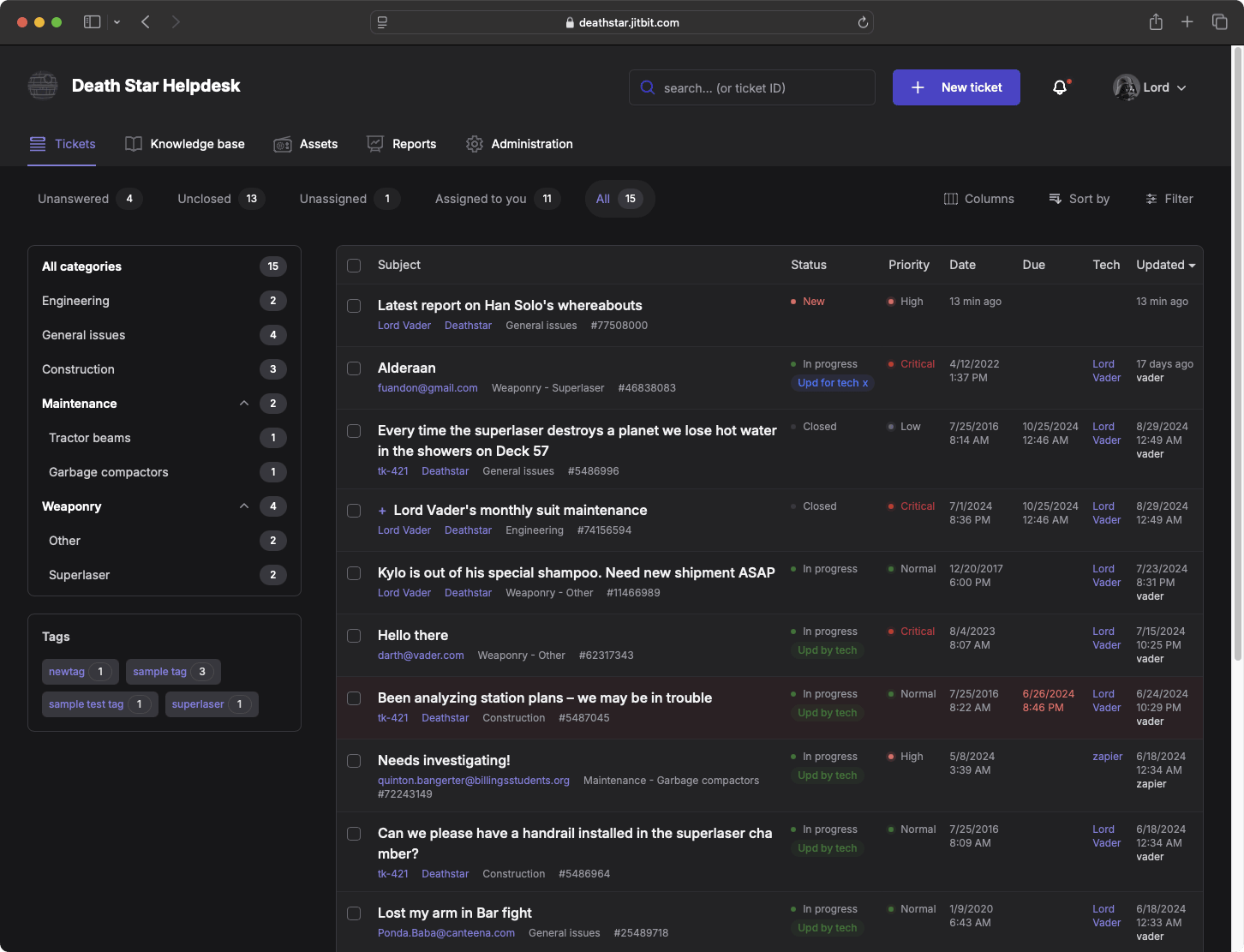
Jitbit is the tool we build, so read this section with that in mind. A lot of ServiceNow instances, once you look closely, are used for three things: taking requests, tracking who has which laptop, and reporting on SLAs. If that's you, Jitbit does those jobs without needing a developer. The ticket list, the reply box, and the asset tied to the ticket are right in front of you; the rest stays out of the way until you need it. Everyone at Jitbit, founders included, works support tickets in Jitbit every day, so we feel every extra click ourselves.
What an IT team gets:
- Built-in asset management - hardware, software licenses and contracts, assigned to users and linked to tickets, with CSV import from your existing data
- Automation rules and SLAs to route, escalate, and close tickets - set up by an admin in a form, not scripted
- AI features - suggested replies from your knowledge base, ticket summaries, and an AI chat that hands off to a technician. Your choice of GPT, Gemini, or Claude
- Email-first ticketing - employees just email IT. There's also a self-service portal and knowledge base
- Active Directory and SSO, a full API, and integrations with Slack, Teams, Jira, and Azure DevOps
Pricing: Jitbit charges per tier, not per seat - $29 to $249 a month, with 9 agents on the top plan and $29 for each one after that. Every core feature is on every plan, and AI credits are unlimited from the Startup plan up. Annual billing takes about two months off. Using it for HR or facilities requests doesn't mean buying another product - it's just another category. If you need data on your own servers, there's a self-hosted version with a one-time license.
Downsides: Jitbit isn't ServiceNow, and it doesn't try to be. There's no formal change or problem management, no CMDB with relationship maps, no discovery, and no low-code app builder. If your organization really uses those, look at HaloITSM or InvGate below.
Jitbit is a profitable, self-funded company - no VC, no private equity, no enterprise sales team. You won't be negotiating a renewal with an account executive. Feature requests go to the people who write the code, and turnaround is often days, not quarters.
2. Freshservice
Best for: mid-sized IT teams that want real ITSM with a modern, easy interface.
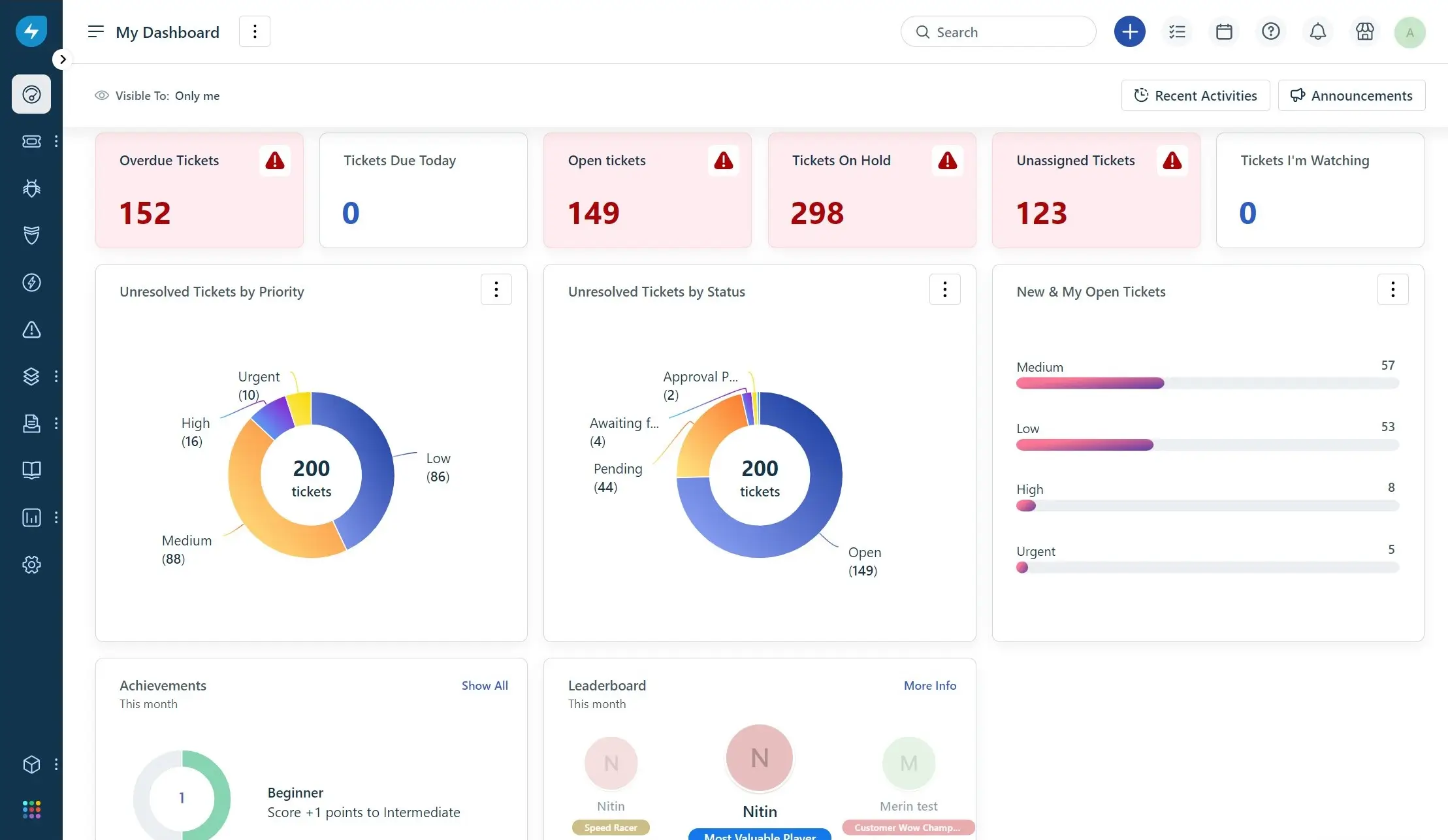
Freshservice is the name that comes up most often when IT people talk about leaving ServiceNow, and the reviews from those who made the move are mostly warm: cheaper, easier to use, and a team that actually likes it. The workflow builder is praised for making complex onboarding flows easy, reporting is good, and it integrates well with Azure AD / Entra ID for automating permissions. Many teams bring in a Freshworks implementation partner for the initial setup, at a fraction of what a ServiceNow project costs.
Pricing: Starter $19, Growth $49, Pro $99 per agent per month on annual billing, Enterprise by quote. Every paid plan includes 100 asset units; more are extra. Freddy AI Copilot adds $29 per agent on Pro and Enterprise.
Downsides: problem, change, and release management start at Pro, so the realistic price for ServiceNow-style ITSM is $99 per agent. Software asset management is weaker than the rest of the product. And since pricing is per agent and per asset, the bill still grows with you - just more slowly. See our Freshservice alternatives guide if you want to compare further.
3. Jira Service Management
Best for: companies where engineering already runs on Jira and Confluence.
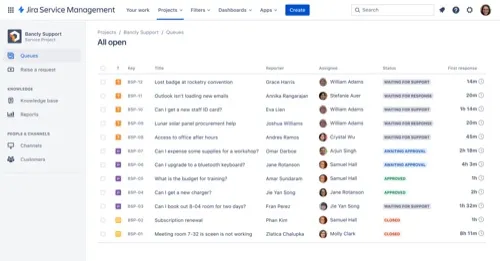
Jira Service Management is the other common landing spot. It's now sold as part of Atlassian's Service Collection, with Assets (a CMDB) and Rovo AI included. The main draw is that an IT request can become a developer issue without anyone copying and pasting. Teams that moved from ServiceNow often say it isn't as powerful, but it works fine and costs a fraction as much.
Pricing: free for up to 3 agents, Standard $20, Premium about $51 per agent per month on annual billing, Enterprise by quote. Assets is included up to 5,000 objects on Standard and 50,000 on Premium.
Downsides: it's easy to end up with a messy instance and nobody to run it - "no Jira admin on the team" is a common regret. Some IT staff find it too shaped around developer workflows, especially if someone tries to use plain Jira instead of JSM. Advanced change and problem management require Premium. More in Jira vs. Jitbit.
4. HaloITSM
Best for: organizations that need most of what ServiceNow does, at one predictable price.
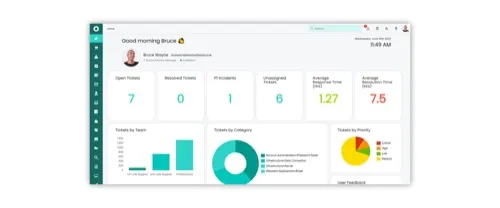
Halo is the closest thing on this list to a "ServiceNow, but cheaper": full ITIL processes, CMDB and asset discovery, automation, AI, project management and reporting, all in a single tier with no add-on modules. That directly fixes one of the biggest ServiceNow complaints - that every new process means a new licence. Its fans say that once you learn it, you can build almost anything.
Pricing: one per-agent price with no feature tiers - £66 per agent per month in the UK, roughly $49-99 in the US depending on the number of agents. 30-day free trial with everything included.
Downsides: it has grown a lot of features over the years, and it shows. Admins describe it as complicated to set up, and some have found workflows harder to build than in Freshservice. There's a public API, but some find its documentation hard to follow. Plan for a real implementation project.
5. InvGate Service Management
Best for: mid-sized and larger IT departments that want ITIL without ServiceNow's complexity or price.
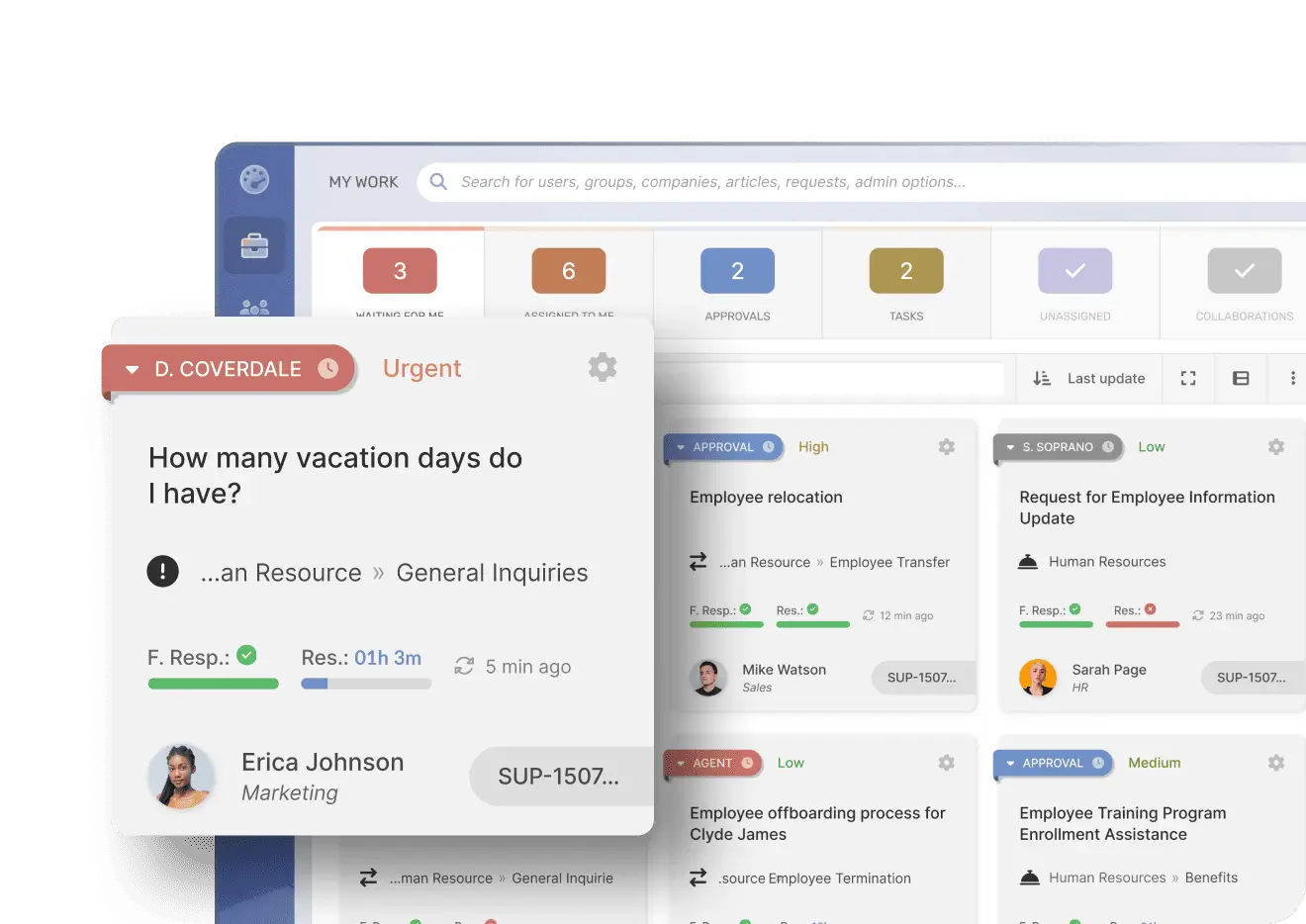
InvGate (formerly InvGate Service Desk) is a quieter pick that shows up often in actual ServiceNow migrations. It covers incident, request, change and release management, a self-service portal, and a workflow builder, with InvGate's asset management product integrated on every plan. Customers like that the company listens to feature requests and follows up on them. Unusually, the Enterprise plan can also be hosted on-premises.
Pricing: Starter is a flat $1,499 a year for up to 5 agents. Pro is $500 per agent per year (about $42 a month) for 5 to 50 agents, and adds the workflow builder, change management, and an AI service agent. Enterprise starts at $12,000 a year.
Downsides: Starter is quite limited, so most teams end up on Pro. Search has been a common complaint. It's also a smaller ecosystem than ServiceNow or Atlassian, with fewer consultants and third-party apps to lean on.
6. ManageEngine ServiceDesk Plus
Best for: budget-conscious IT departments that want classic ITIL processes, in the cloud or on-premises.
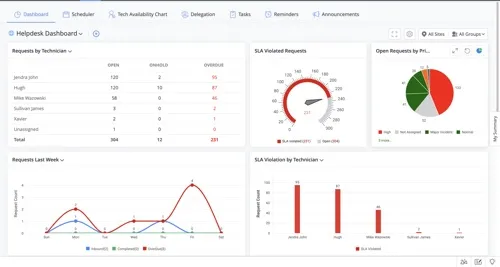
ServiceDesk Plus has been around a long time and covers the ITIL basics: incidents, problems, changes, a service catalog, CMDB, and asset management. It also connects to the rest of ManageEngine's IT tools, like Endpoint Central for patching. If you want ServiceNow's process model at a fraction of the cost, it's one of the cheapest ways to get it.
Pricing: Standard from $13, Professional (adds asset management) from $27, Enterprise from $67 per technician per month. The Standard edition is free for up to 5 technicians. Many ITIL modules are add-ons, and asset counts affect the price.
Downsides: the interface is dense and dated. The on-premises version needs looking after - failed service pack upgrades and database issues come up. "Starts from" means what it says, so get a real quote before comparing.
Before You Switch
A few things people wish they had known before leaving ServiceNow:
- Plan for historical data. Moving years of tickets, CMDB records and custom tables is the hardest part, and some teams end up starting fresh and keeping the old instance read-only. Decide early what you really need to bring across - often it's less than you think.
- Watch the overlap period. You'll likely be paying for both systems during the migration. Check your ServiceNow contract dates before you commit to a go-live.
- Don't rebuild everything. Most custom ServiceNow code was written to work around something. Treat the move as a chance to simplify, not to reproduce every workflow one-to-one.
- Name an owner. Whatever you choose, someone on the team needs to own the tool. Every platform gets messy when nobody does - including the cheap ones.
How to Choose
Start from what your team actually used ServiceNow for, not from its feature list:
- Mostly tickets, assets, and SLA reports? You don't need an ITSM platform. Jitbit, and you'll likely cut the bill by 80% or more.
- Formal ITIL processes, CMDB, change advisory boards? HaloITSM, InvGate, or Freshservice Pro.
- Engineering already lives in Jira? Jira Service Management - but make sure someone knows how to run it.
- Tight budget and need on-premises? ManageEngine ServiceDesk Plus, or Jitbit's self-hosted version for a lighter setup.
- HR, facilities, and other departments want in? Look for pricing that doesn't charge per module. Halo and Jitbit don't.
- Really using ServiceNow as a platform - custom apps, many departments, a team to run it? Then it may be worth what it costs. Renegotiate instead of leaving.
If you're also comparing customer-facing helpdesks, see our Zendesk alternatives and Freshdesk alternatives guides, or the full list of comparisons.
If a simple, flat-priced IT helpdesk sounds like enough, start a free Jitbit trial - no credit card required - import your assets from CSV, and run a week of real requests through it. If you need more time to evaluate, we're happy to extend the trial.
Features
9 reasons to choose Hosted Zendesk vs. Jitbit Compare alternatives What is SaaS Active Directory Authentication Cloud Help Desk Free Email account and more Authentication API Online Ticketing System Benefits Single Sign On SLA and Help Desk Automation Helpdesk API Helpdesk for your industryResources
Customer reviews User guide FAQ What's new Version history Free trial Pricing