Best OTRS Alternatives in 2026
For about fifteen years, OTRS was the default answer to "we need a free, self-hosted ticket system that can do serious IT work." Then, in December 2020, OTRS AG ended the free ((OTRS)) Community Edition. Today OTRS is a commercial subscription in three bundles - Starter, Advanced and Pro - and none of them has a public price. The free code lives on in community forks, but anyone who built on the original got a forced decision: pay, fork, or leave.
Most of the people searching for an OTRS alternative are in the same spot: an IT department running OTRS on its own Linux server, often an old 5.x or 6.x install that hasn't been upgraded in years. Many of them want to stay on-premises. Below are the options worth looking at in 2026, with current pricing and honest downsides - including the free ones.
Table of Contents
- What Changed with OTRS
- Pricing at a Glance
- What a 10-Agent Team Pays Over Three Years
- 1. Jitbit Helpdesk
- 2. Znuny
- 3. Zammad
- 4. osTicket
- 5. GLPI
- 6. Freshservice
- Before You Switch
- How to Choose
What Changed with OTRS
- The free edition is gone. ((OTRS)) Community Edition 6 reached end of life on December 31, 2020. No more security patches from OTRS AG.
- The commercial product is quote-only. Starter, Advanced and Pro differ mainly in asset limits and support level. AI credits, extra storage, extra assets and on-premises hosting are extras on top. You won't know the price until you talk to sales.
- It's cloud-first. On-premises is still possible, but as an added service rather than the default.
- It was never easy. Even when it was free, OTRS came with a thick admin manual, training seminars that cost around $2,000 per attendee, and a Perl stack that needed someone who knew it.
That leaves three paths: stay on the same code with a community fork, move to another open-source tool, or buy something that's simpler to run. All three are on the list below.
Pricing at a Glance
Cloud prices are per agent per month on annual billing unless noted. OTRS is included for reference.
| Tool | Self-hosted | Cloud | Stack (self-hosted) | ITSM / assets |
|---|---|---|---|---|
| Jitbit | One-time, $2,490 for 10 agents | $29-249/mo flat per team | .NET + SQL Server, Windows or Linux | Assets, SLAs, approvals |
| OTRS | Quote, as an add-on service | Quote only | Perl | Yes |
| Znuny | Free (GPL), paid support on request | Managed hosting, quote | Perl + MySQL/PostgreSQL | Yes, ITSM packages |
| Zammad | Free (AGPL), support from €2,999/yr | €7 / €16 / €25 | Ruby on Rails + PostgreSQL + Elasticsearch | No |
| osTicket | Free (GPL) | $12-24 | PHP + MySQL | No |
| GLPI | Free (GPL), support from €100/mo | €19 | PHP + MySQL | Yes, strong inventory |
| Freshservice | No | $19 / $49 / $99 | - | Yes |
List prices from each vendor's pricing page, October 2026. Euro prices exclude VAT. Vendors change prices often - check before you buy.
What a 10-Agent Team Pays Over Three Years
Self-hosted figures are license and paid support only. Your own server and admin time come on top for every self-hosted option - and with the Perl-based ones, admin time is the bigger number.
| Tool & plan | 10 agents, 3 years |
|---|---|
| Jitbit, self-hosted | $2,490 one-time; $4,988 if you also renew updates in years 2 and 3 |
| Jitbit, cloud | $10,008 on monthly billing, less on annual - AI and assets included |
| OTRS | Quote only, plus training and implementation |
| Znuny | $0 without support; commercial support by quote |
| Zammad | $0 self-hosted without support (€8,997 with Business support); €5,760 on Professional cloud |
| osTicket | $0 self-hosted; $4,320-8,640 on cloud |
| GLPI | $0 self-hosted (€3,600 with Basic support); €6,840 on cloud |
| Freshservice Growth | $17,640 |
1. Jitbit Helpdesk
Best for: IT teams that want to stay on-premises, but with a tool the whole team can use without training.
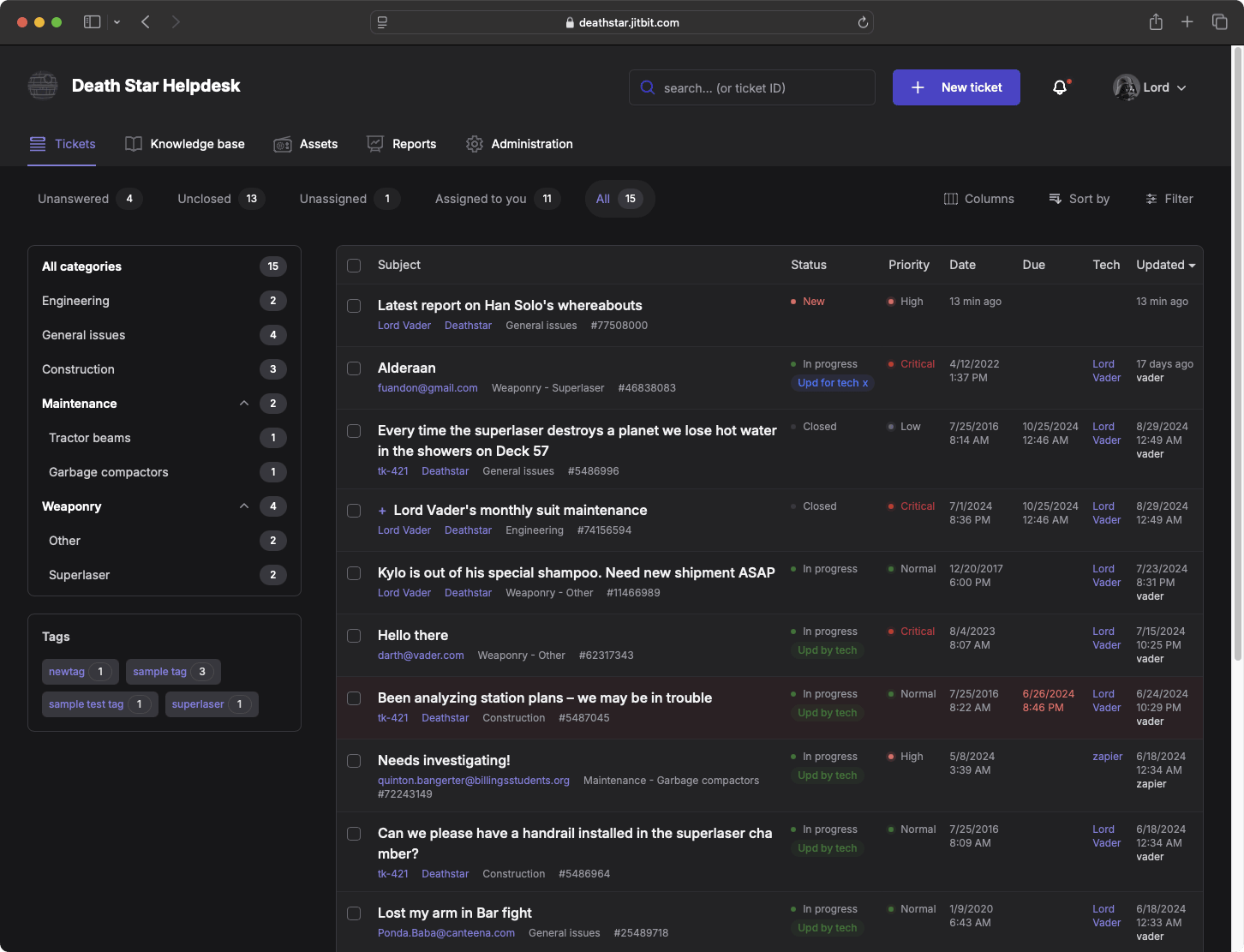
Jitbit is the tool we build, so read this section with that in mind. It's the opposite of OTRS in one important way: it's meant to be simple. The ticket list, the reply box and the customer's history are in front of you, and the rest stays out of the way until you need it. Most teams are answering tickets the same day they install it - no seminar required.
It also takes self-hosting seriously, which is where most OTRS users are coming from. The self-hosted version runs on Windows Server or Linux (including Docker), with .NET and SQL Server - the free Express edition is fine for most teams. What you get:
- Automation rules and SLAs - routing, escalations and time-based triggers, set up in a form instead of a process editor
- Asset management linked to tickets and users, plus Active Directory and SSO
- AI that works with the self-hosted version - reply drafts from your knowledge base, summaries, triage
- A full REST API, webhooks, and integrations with Teams, Slack, Jira and more
- Native iOS and Android apps, a customer portal and a knowledge base
Pricing: the self-hosted license is a one-time payment - $2,490 for 10 agents, up to $16,990 for unlimited agents - and every price is on the website. It includes 12 months of updates; after that the software keeps working, and renewing updates costs half the license price. The cloud version is $29 to $249 a month for the whole team, not per agent.
Downsides: it's not open source, and it's not a full ITIL suite - no CMDB with relationship maps, no formal change advisory workflow, nothing like OTRS's process management for modeling complex multi-step processes. If you really use those, look at Znuny or GLPI. More detail in our OTRS vs. Jitbit comparison.
Jitbit is a profitable, self-funded company that has been building helpdesk software for over 18 years. No surprise license changes: if you buy a perpetual license, it stays perpetual.
2. Znuny
Best for: teams that like OTRS as it is and just want it maintained.
Znuny is the community fork of ((OTRS)) Community Edition, maintained since 2021 by Znuny GmbH in Berlin. It's the closest thing to "keep using OTRS for free": same Perl codebase, same agent interface, same ticket and ITSM concepts. Coming from OTRS 6, moving to Znuny is closer to an upgrade than a migration - your configuration, queues and data come along. It's actively developed, with a long-term support branch (LTS 6.5) and a current 7.x line. Another fork, OTOBO, is worth a look too, especially in German-speaking countries.
Pricing: free under the GPL. Znuny GmbH sells support, managed hosting and add-ons by quote.
Downsides: you keep everything that made OTRS hard - the Perl stack, the complexity, the dated UI, the learning curve for new agents. It solves the license problem, not the usability one. And if your install is very old, the upgrade path through several versions takes real work.
3. Zammad
Best for: teams that want to stay open source but get a modern interface.
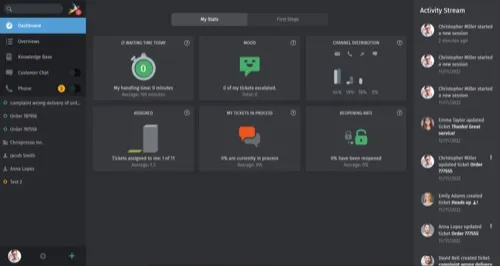
Zammad was started by one of the original OTRS founders, and it shows: it's the open-source helpdesk most often picked by teams leaving OTRS. The interface is clean and fast, it handles email, chat, phone, Telegram, WhatsApp and social channels, and it has triggers, SLAs, a knowledge base, a full API and LDAP/SSO. There's a built-in OTRS importer, and both the company and the hosted data are in Germany.
Pricing: self-hosted is free under the AGPL; paid support starts at €2,999 a year. Hosted plans are €7 (Starter, max 5 agents), €16 (Professional, max 35 agents) and €25 (Plus) per agent per month on annual billing. AI features are billed per call.
Downsides: it's a customer-support helpdesk, not ITSM - no CMDB, no asset management, no change management. If you used OTRS's ITSM modules, you'll miss them. Self-hosting needs Elasticsearch and Redis alongside PostgreSQL, and workflows and advanced reporting are on the top hosted plan only.
4. osTicket
Best for: small IT teams that used maybe 10% of OTRS and want something simpler and free.
osTicket is the other classic free, self-hosted ticket system, on a PHP/MySQL stack that's easier to run than OTRS's Perl. It covers email piping, help topics, custom forms, SLAs and a knowledge base. If your OTRS was mostly a shared queue with some categories, osTicket will feel lighter.
Pricing: free under the GPL. A hosted version costs $12-24 per agent per month.
Downsides: the 1.x branch is in maintenance mode - security fixes only, no feature release since 2023 - while a 2.0 rewrite has no date. The API only creates tickets, automation only runs when a ticket is created, and there are no official mobile apps or AI. You'd be moving from one stalled product to another. See our osTicket alternatives for more on that.
5. GLPI
Best for: IT departments that relied on OTRS's ITSM side and want free ITSM with real asset inventory.
GLPI is a French open-source IT management suite, backed by Teclib. It covers incidents, requests, problems, changes, a service catalog and SLAs, and its strongest part is asset management - the GLPI Agent inventories your hardware and software automatically. Among free tools, it's the closest match to what OTRS with ITSM modules did, and it runs on a PHP/MySQL stack.
Pricing: free under the GPL. Teclib sells cloud hosting at €19 per agent per month (45-day trial), and support for self-hosted installs from €100 a month for up to 10 agents.
Downsides: the interface is dense, and ticket handling is just one part of a big product, so agents who only answer tickets may find it heavy. Plugins sometimes break on upgrades. Like OTRS, it rewards people who invest time in setting it up.
6. Freshservice
Best for: teams ready to give up self-hosting for an easy cloud ITSM.
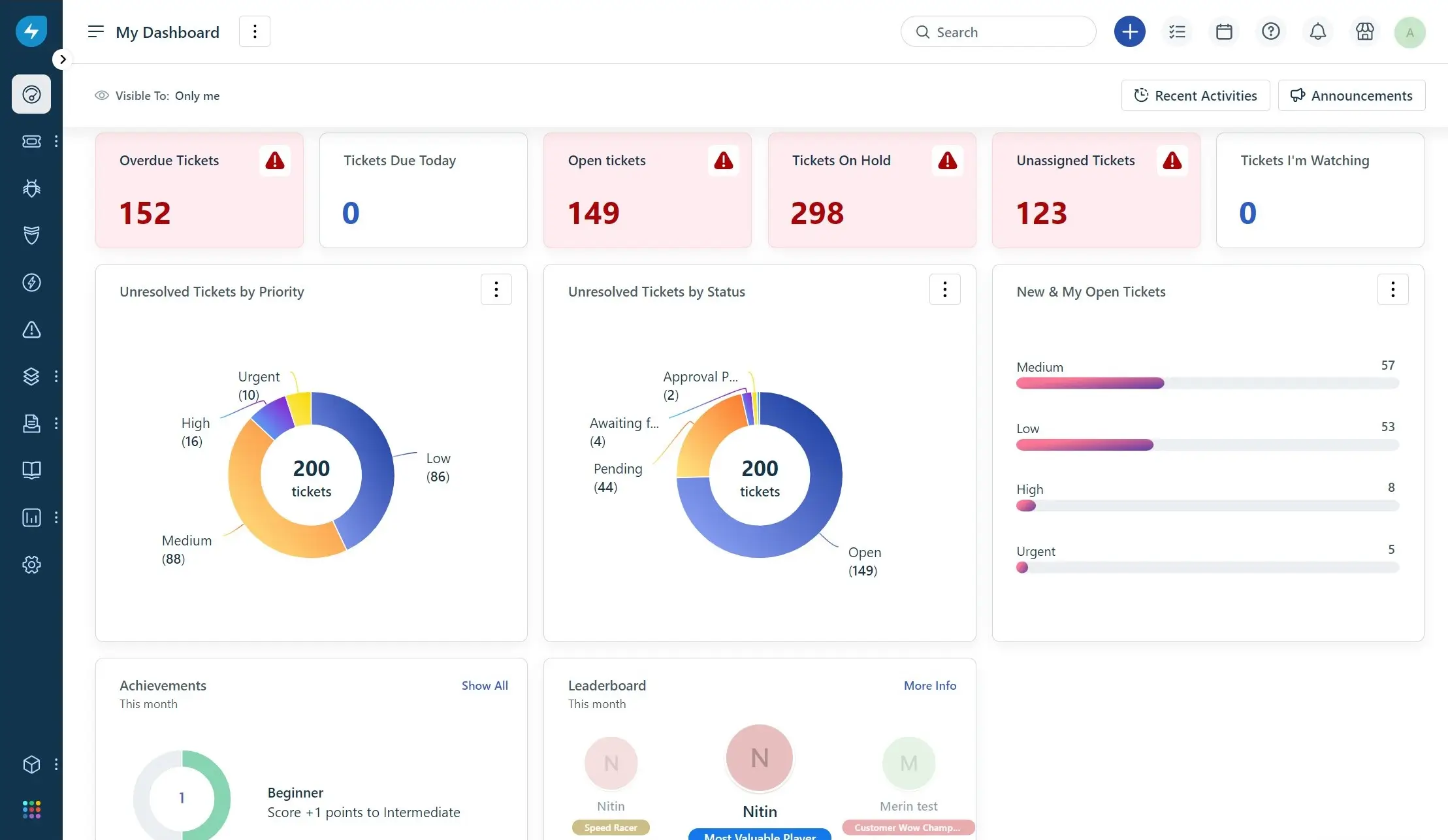
Freshservice is the polished cloud option: easy to set up, a well-liked workflow builder, incidents, a service catalog, asset management, and integrations with Entra ID and Intune. Teams that leave OTRS for it mostly say the same thing - their agents finally like the tool.
Pricing: Starter $19, Growth $49, Pro $99 per agent per month on annual billing, Enterprise by quote. Freddy AI Copilot adds $29 per agent on Pro and Enterprise.
Downsides: cloud only, which rules it out for many OTRS shops with data-residency rules. Problem and change management start at Pro, and the bill grows with every agent and asset. See our Freshservice alternatives guide to compare further.
Before You Switch
- List what you actually use. OTRS installs collect years of queues, dynamic fields, ACLs and Generic Agent jobs. Most of it can go. Write down the five things your team really relies on, and test candidates against those.
- Plan for the data. OTRS stores everything in MySQL or PostgreSQL, and its Generic Interface can export tickets. Many teams bring over open tickets, customers and FAQ articles, and keep the old system read-only for history.
- Check your version. If you're still on OTRS 5 or 6, you're running software with no security patches. That's a reason to move soon, whichever way you go.
- Count admin time honestly. Free software isn't free if it takes a week of a sysadmin's time every upgrade.
How to Choose
- Want to stay on-premises with something your team can use from day one? Jitbit - one-time license, published prices, runs on Windows or Linux.
- Happy with OTRS, just not with the license? Znuny. It's the smallest change.
- Must stay open source, mostly customer support? Zammad.
- Need ITSM and asset inventory for free? GLPI.
- Small team, simple queue? osTicket, keeping its maintenance mode in mind.
- Done with servers? Freshservice, or Jitbit's cloud version if you'd rather not pay per agent.
See also our self-hosted helpdesks for Linux overview, the ServiceNow alternatives guide for heavier ITSM, or the full list of comparisons.
Download the self-hosted trial and run it next to your OTRS install, or start a free cloud trial - no credit card either way. Our support team, the people who wrote the product, will help you plan the move for free.
Explore Jitbit Helpdesk
Helpdesk features Hosted vs On-Premises Zendesk vs. Jitbit Compare alternatives Outlook Help Desk A Simple Support Ticket System System Requirements MS Teams and other integrations Help Desk Demo Email ticketing system GDPR Compliant Help Desk Software How does it work? ASP.NET help desk Helpdesk API Case Studies Customer reviews User guide FAQ Version history Download now Pricing